














































































































In addition to the tests carried out in the laboratory, Green NCAP also conducts a Real-world mixed drive, during which tailpipe emissions are sampled and electricity consumption measured. The basis of this test is the Real Driving Emissions (RDE) assessment, introduced into legislation in 2018 to try to control and reduce the gap between emissions values measured in the lab and those emitted in the real world. In 2025, Green NCAP’s definition of the test was changed to represent a standard mixed trip with a more eco-minded driver – the dynamic requirements were lowered, the maximum speed adapted and the auxiliary usage revised. The test is performed with active cabin climatization, radio, headlights and active navigational system. The set operational mode is the most ecological one and the maximum energy recuperation level is chosen.
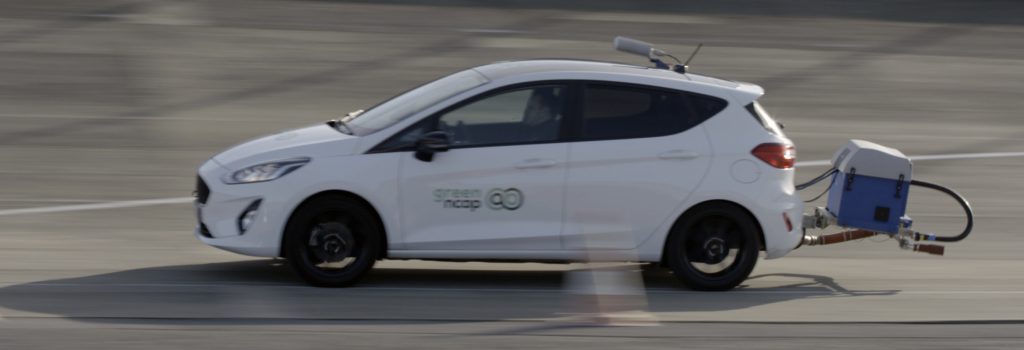
The drive is split into three parts, representing urban, rural and motorway driving, and exhaust gases are analysed at the tailpipe by a Portable Emissions Measurement System (PEMS), attached to the back of the car. The pollutant emissions measured are NOx, CO and PN10.
The real-world tests include:
- Real-world mixed drive (a realistic eco-friendly real world trip with cold powertrain start)
In post-processing, the vehicle’s behaviours in the cold start stage of the Real-world mixed drive is extracted and evaluated as a strong evidence for robustness performance:
- Short city trip (first 8 km of the Real-world mixed drive)
- Congestion simulation (15 min idling, 5 min stop & go to simulate heavy congestion)
Plug-in hybrid electric vehicles (PHEVs) perform the Real-world mixed drive in two different modes – charge-sustaining mode (CS, i.e. when running mainly using the combustion engine) and charge-depleting mode (CD, i.e. when the test starts with a fully charged battery). With PHEVs, PEMS+ Eco and PEMS+ Heavy are conducted only in charge-depleting mode (CD). Plug-in hybrids are subject to PEMS+ Congestion simulation only in CS mode.